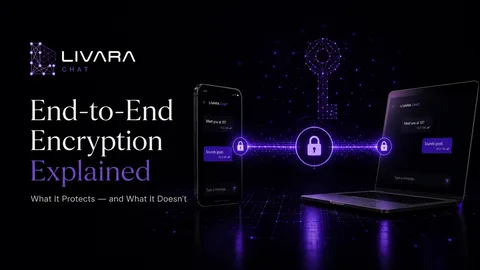
End-to-end encryptionUnderstand the seal. Know its limits.
✳01
End-to-end encryption explained: message keys, encrypted groups, verification, recovery and the boundaries that matter.
Start with a simple question: who can read the message? These guides explain end-to-end encryption through the things people actually do: send a photo, join a group, verify a contact, or restore a conversation.
Follow the details as far as you need. The collection covers message keys, sender-key groups, identity verification and the places where encryption stops protecting a conversation.
A perfectly sealed message can still hand over your home address, because smartphone photos carry GPS coordinates and device details inside the file itself. Here is what EXIF metadata in chat apps actually leaks, why end-to-end encryption does not remove it, and how to strip it before you send.
Livara runs the same hybrid post-quantum encryption on web and Android, so the ciphertext is identical — but the browser tab carries a threat surface the native app does not. Here is where each one is strong, and where each one loses.
Your keyboard sees what you type before end-to-end encryption ever applies. A practical look at third-party IME privacy on Android, what a keyboard can technically do with your chats, and how to pick one that does not read them.
End-to-end encryption protects messages while they travel and while they sit on a server as ciphertext. It cannot stop a screenshot, a screen recording or a lock-screen preview, because all three happen after the message has already been decrypted on someone else's device.
Android messenger session theft can expose an encrypted chat after the legitimate user has unlocked it. End-to-end encryption protects the message on its journey, but it cannot keep plaintext secret from malware that can read, capture or remotely control the authorised phone displaying it.
Discover why 'military-grade encryption' is a marketing illusion, and learn how to evaluate private messengers using transparent, verifiable cryptographic primitives.
A detailed technical comparison between the IETF Messaging Layer Security (MLS) tree-based ratchet and Livara's hybrid post-quantum LGS1 sender-key architecture.
Client-side scanning bypasses encryption by reading your messages before they are locked. Discover how verifiable APK integrity stops hidden surveillance modules.
Pairwise post-quantum key exchanges overwhelm network bandwidth in large group chats. The LGS1 protocol solves this scaling bottleneck by wrapping group sender keys inside hybrid post-quantum LVR1 envelopes.
Many messaging platforms treat encryption as an optional extra. We contrast the reality of opt-in privacy against uncompromising, default post-quantum security.
Many popular messaging apps require users to manually enable encryption, leaving conversations exposed by default. We compare out-of-the-box privacy and explain why always-on encryption wins.
When an encrypted group chat kicks out a member, cached encryption keys can leave future messages exposed. Here is how LGS1 enforces instant backward secrecy.
Cryptographic identity recovery restores a user's private decryption keys on a new device using zero-knowledge mechanics, eliminating the need to store unencrypted keys on a central server. By pairing the SRP authentication protocol with client-side key derivation, modern platforms reconstruct secre
When law enforcement targets a private messenger, the data they extract depends entirely on the cryptographic architecture. We explore how E2EE limits subpoena compliance to basic metadata.
Usually, someone running or monitoring public Wi-Fi cannot read the content of properly end-to-end encrypted messages. However, public Wi-Fi still creates risks: a rogue hotspot may imitate the real network, observers may learn connection details, and phishing or an insecure device may expose inform
Android 16 Advanced Protection adds device-level safeguards against risky apps, unsafe links, insecure networks and targeted attacks. It can strengthen private messaging on Android, but it does not encrypt conversations by itself or replace the end-to-end encryption supplied by apps such as Livara.
Yes, your employer may be able to see messages or message content on a work phone, even when an app uses end-to-end encryption. Encryption protects messages while they travel between participants, but it cannot prevent screenshots, screen monitoring, notification previews, device access or disclosur
End-to-end encryption protects messages in transit, but a thief holding an unlocked phone may see what you can see. To protect private messages on a stolen phone, you need safeguards before the loss and swift containment afterwards. This guide explains the risks, how to secure encrypted chats after